GitHub Copilot vs Revolte
Copilot made coding faster. Did it make delivery faster?
GitHub Copilot is the most widely adopted AI assistant in engineering. Revolte is an AI platform for software engineering that turns adoption into delivery outcomes - executing testing, validation, release, and deployment from intent to production, and measuring whether anything actually improved.

AI Initiative - Status Review

The Adoption Paradox
Adoption was
the easy part.
Rolling out Copilot is a procurement decision. Most engineering organizations have already made it - seats provisioned, extensions installed, suggestions accepted.
Then the board asks what changed. In most organizations, developers feel faster while releases ship at the same pace. The code stage accelerated. The lifecycle around it did not.
AI adoption is not AI transformation. The difference is a platform that executes and measures the rest of the lifecycle.See Revolte deliver software

Prove it worked
Usage is not outcome.
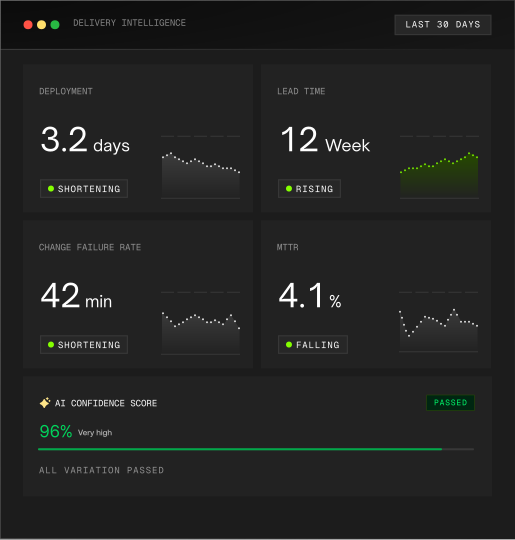
Copilot's dashboards show adoption: active seats, suggestions, acceptance rates. These prove usage but not faster shipping, fewer bugs, or lower costs. Measuring the lifecycle is needed.

SIDE-BY-SIDE MATRIX
Capabilities Comparison Matrix
Evaluate how GitHub Copilot's AI-assisted coding stacks up against Revolte's enterprise-ready delivery platform.



Assists planning conversationally; no governed execution plan tied to delivery workflows.

Interprets Jira, Linear, and Figma specs, maps dependencies, and drafts a full execution plan.
Best-in-class suggestions, chat, and code generation across editors and GitHub.
Specialized agents write modular, complete changes adhering to system standards, as one stage of a governed run.
Can summarize and comment on pull requests; approval and enforcement stay outside the tool.
Agents prepare reviews with evidence; human approval gates decide what merges.
Drafts tests on request; running and gating on them is your CI's job.
Automated test generation, runtime execution, coverage verification, and regression evidence attached to every run.
No environment provisioning or management.
Provisions governed preview, staging, and test environments as part of the workflow.
Deployment runs on separately configured pipelines, outside Copilot's scope.
Orchestrates deployment gates, staged releases, and rollback paths through your CI/CD.
Active in the editor and repository; no production feedback loop.
Connects runtime signals back into engineering workflows for governed resolution.
Suggestions are accepted or rejected by the developer; there is no workflow-level approval structure.
Policy decides which actions run autonomously and which require human sign-off, with full audit trails.
Usage and adoption metrics; no telemetry connecting AI use to delivery outcomes.
Delivery Intelligence built in: DORA, FLOW, AI ROI, and AI Confidence Score on every workflow.
Mature enterprise policies, privacy controls, and IP protections at the assistant layer.
Control AI use, changes, costs, and code location at workflow level. Customer-controlled deployment when applicable.
Per-seat subscription; cost scales with headcount regardless of delivery outcomes.
Priced by the applications and services it manages; adding developers never adds cost.
Triggers
When Revolte Kicks In
However work starts, Revolte ties into the tools your team already uses and carries execution from intent to production.

Commit & Push Events
Code pushed to your repository — from any editor — spins up a Revolte workflow run: build, generated regression tests, evidence attached.
TARGET: Continuous Integration
Pull Requests
Opening or updating a PR triggers isolated staging deployment, automated QA checks, and review-ready evidence.
TARGET: QA & Preview Hostings
Issue / Task Creation
A labeled Jira or Linear ticket becomes engineering intent: Revolte maps dependencies, drafts an execution plan, and spawns agents.
TARGET: Intent-to-Execution
Chat Commands
Invoke Revolte from Slack or Teams to launch tests, checks, or governed operations on demand.
TARGET: Conversational Operations
Scheduled Runs
Recurring maintenance workflows — dependency upgrades, security checks, nightly regression — executed in governed environments.
TARGET: Routine Maintenance
CLI / Web Console
Developers invoke workflow runs directly from the CLI or platform console, keeping explicit control.
TARGET: Developer InvocationThe Cost Model
Seat math vs service math.
How the investment architectures scale against engineering productivity.

SPEND GROWS WITH IT

Priced by what Revolte manages — not by seats.
GitHub Copilot is licensed per developer seat. Revolte is priced by the applications and services it manages, so adding developers never adds cost.
$149/month
Unlike Copilot's per-seat pricing that scales with headcount, Revolte offers transparent tiers starting at $0 for startups to grow gradually.
 Governed AI workflow runs across your lifecycle
- Human-in-the-loop approval gates and audit trails
- DORA, FLOW, AI ROI, and AI Confidence Score telemetry
- Managed preview, staging, and release environments
Frequently Asked
Questions
No - Revolte executes the lifecycle regardless of which editor your developers prefer. But this page isn't about pairing tools. It's about where delivery actually gets decided: the editor covers one stage; Revolte orchestrates, governs, and measures all of them.



Bring AI execution to your
engineering team.
See how Revolte delivers software faster - with your engineers in control. Fill out our pilot request form below.